Tuesday, July 2, 2013

Storm Update

On June 27th at 5:00 we experienced a severe storm that moved through Forest Lake and surrounding areas.  Although the storm was short, the winds were extreme and we received over 2 inches of rainfall in about 30 minutes.  It has been almost 5 years since we have experienced a storm like this.  The club lost power service for 2 days.  On the course we lost 2 trees (a Basswood on #16, and a Little Leaf Linden in front of #18 green), and many branches that were scattered from corner to corner of the golf course.  Water from the storm created many ponds on fairways and roughs. Below are a few pictures from Thursday evening.

#16 fairway
#16 fairway from 15 Tee

Basswood #16
#9 fairway
#15 fairway
#18 green
#16/#17 Basswood row

Silver Maple #7
Power lines down across Club Drive
Friday morning the greens crew started working at cleaning up branches and removing the fallen trees, as well as fixing almost every sand trap on the course..

Cleanup begins!

Chipping branches
Fixing Bunker washouts
Most of the water found its way into the network of course drains.  The course remained open Friday for walkers and was opened for golf carts on Saturday morning.  We are still dealing with flooding in the driving range, (picture on right) because of the excess water from Forest Lake moving through the course.  Although Forest Lake will be draining for the next couple of weeks we should be able to catch up and remove the excess surface water.
Pond over flowing #2 cart path
New lake on the bottom of the range
Pumping excess water out of the driving range


Friday, June 7, 2013

Tree planting

Trees in our parking lot after delivery
Over the past 10 days the greens crew has planted 34 new trees on the golf course.  These trees were hand selected by the Greens committee at a local nursery.  The trees were picked for many different reasons;

- To provide the right sized tree for strategic locations determined during master planning
- To add tree diversity to FLCC.
- Unique colors and characteristics of leaves and flowers through the season.
Planting an Autumn Blaze Maple
- Hardiness and adaptability to environmental conditions and varying soils on the  property.

The new trees will take a few years to establish their roots into the native soils on the property.  We will typically see signs that trees have adapted well in year 2 or 3, as the trees will start showing a fuller canopy.  The trees we plant today will take many years to reach maturity and serve their desired function.


Below are some pictures of the trees and locations on the golf course


Eastern Redbud (CERCIS c. 'Forest Pansy)

- 3 Planted at #3 tee
 
Autumn Blaze Red Maple (ACER x 'Autumn Blaze')

- 2 Planted left side of #1 fairway
- 2 Planted left side hole #9
Pink Flowering Crab apple (MALUS 'Prairifire')

- 2 Planted right side of #1 green
Kentucky Coffee Tree (GYMNOCLADUS dioicus)

- 2 Planted in behind #3 green
Northern Red Oak (QUERCUS rubra)

- 1 Planted between #3 green and #5 fairway
- 1 Planted left side #9 green
Northern Pin Oak (QUERCUS ellipsoidalis)

- 2 Planted right of #5 fairway bunkers
- 3 Planted between holes#16 and #18
Vanderwolf Limber Pine (PINUS  'Vanderwolf')

- 3 Planted between #7 green and hole #13
 
Autumn Gold Maidenhair Tree (GINKO 'Autumn Gold')

- 3 Planted between holes #11 and #12
- 1 Planted left side #5 Tee
Multi-stem Autumn Blaze Red Maple (ACER x 'Autumn Blaze' MS)

- 1 Planted beside #13 Ladie's Tee
Tricolor Beech  (FAGUS s. 'Roseo-marginata')

- 1 Planted at #15 Tee

Crimson King Norway Maple (ACER pl. "Crimson King')

- 1 Planted in behind #15 Green
 
Gold Rush Dawn Redwood (METASEQUOIA 'Gold Rush')

- 3 Planted left side #17

Norway Spruce (PICEA abies)

- 3 Planted left side #17


Friday, May 10, 2013

Course Conditions

Will we ever catch up!  Warm weather and a wet start to the spring has provided great conditions for grass to actively grow.  And I mean actively grow!   The greens crew is working hard at trying to keep the grass at desirable heights.  Unfortunately with the rapid growth, we are having to turn around and cut  roughs 2-3 times a week.  Also we have to deal with trying to spread out clumping grass.

Greens as well go through the same cycle this time of year, where all of the energy reserves they have stored through the winter, and spring fertilization transfers into rapid growth.  There are many tricks and tools to try to keep greens speed desirable and consistent from green to green, which go beyond just mowing and rolling.  Whether it is the use of growth regulators, fertilizing techniques, wetting agents, regulating overhead watering, or vertical mowing and topdressing.  Balancing these processes varies from golf course to course, and as well each individual greens requirements on that course. 

Vertical mowing is done for the following reasons;

- Remove excessive leaf growth that contributes to puffy, spongy surface conditions.
- Improve mowing quality and surface smoothness.
- Cut laterally growing stolons and promote an upright growth habit.
- Open grooves in the turf canopy for the incorporation of sand topdressing.

This process is done frequently in the spring time as the grass on greens is very dense and actively growing.  Periodically through the season we will vertical cut as needed.  Vertical cutting is also preformed on our tees and fairways.

Below are a few pictures of this process


Close up of a vertical cutting reel
#4 Green vertical cut before cleaning
#4 Green Collar
Green cleaned up after being vertical cut
Dragging in Topdressing sand

Wildlife at FLCC

The golf course at Forest Lake provides a perfect corridor for wildlife to live and pass through.  Over the past few weeks we have been able to capture a few of our wild life visitors on the course.  We hope you have an opportunity to catch a glimpse during your golf round.

Swan - Hole #5
Wild Turkey - Hole #6
Egret - Hole #6
Mallard Ducks - Hole #7
Snapping Turtle - Hole #2
Snapping Turtle under water - Hole #5

Spring Trees

Spring is a great time to be out on the golf course.  The weather has been fantastic over the last 10 days and we have seen many players back on the golf course.  Part of the golf experience is being able to appreciate the environment.  The grass has greened up across the course and we are in perfect timing to appreciate all of the vibrant colors of plants and trees.  Trees on the golf course serve many purposes.  They can define golf holes and how they are played, to add to the strategy of the hole.  They also can be used as a noise and visual barricade to eliminate visual and noise distractions.  Other trees are placed on the golf course and property to enhance the property from leaf textures and their flowering colors.  Below are a few examples.

Flowering Crab #4
Cleveland Pear #10 Green
Purple Beech #15 /16
Forsythia #9 Tee
Weeping Ornamentals

Friday, May 3, 2013

Course Conditions

Warmer weather has finally arrived, and with the abundance of rainfall we have received, grass has really greened up and started to rapidly grow.  The greens crew went from having nothing to mow to having to double cut to keep up in 1 week. 

      One thing we always experience this time of year is a dramatic decrease in green speeds.  This is again caused by rapid growth, and wet conditions, causing the greens to become very dense.  When putting on the greens even though the cut looks very tight, the turf actually feels sticky. Over the next 2 weeks, our biggest challenge will be on trying to keep the greens speeds desirable.


We have been working through some of the detailing projects on the course.   Over the next month a lot of our focus is on some of the details that go beyond maintaining the course for everyday play.  Here are a few projects we have been working on over the past couple weeks.   The pictures below show the crew hand edging the bunkers to create a nice crisp edge

Edging #11 green side bunkers
 
Removing grass from the edge

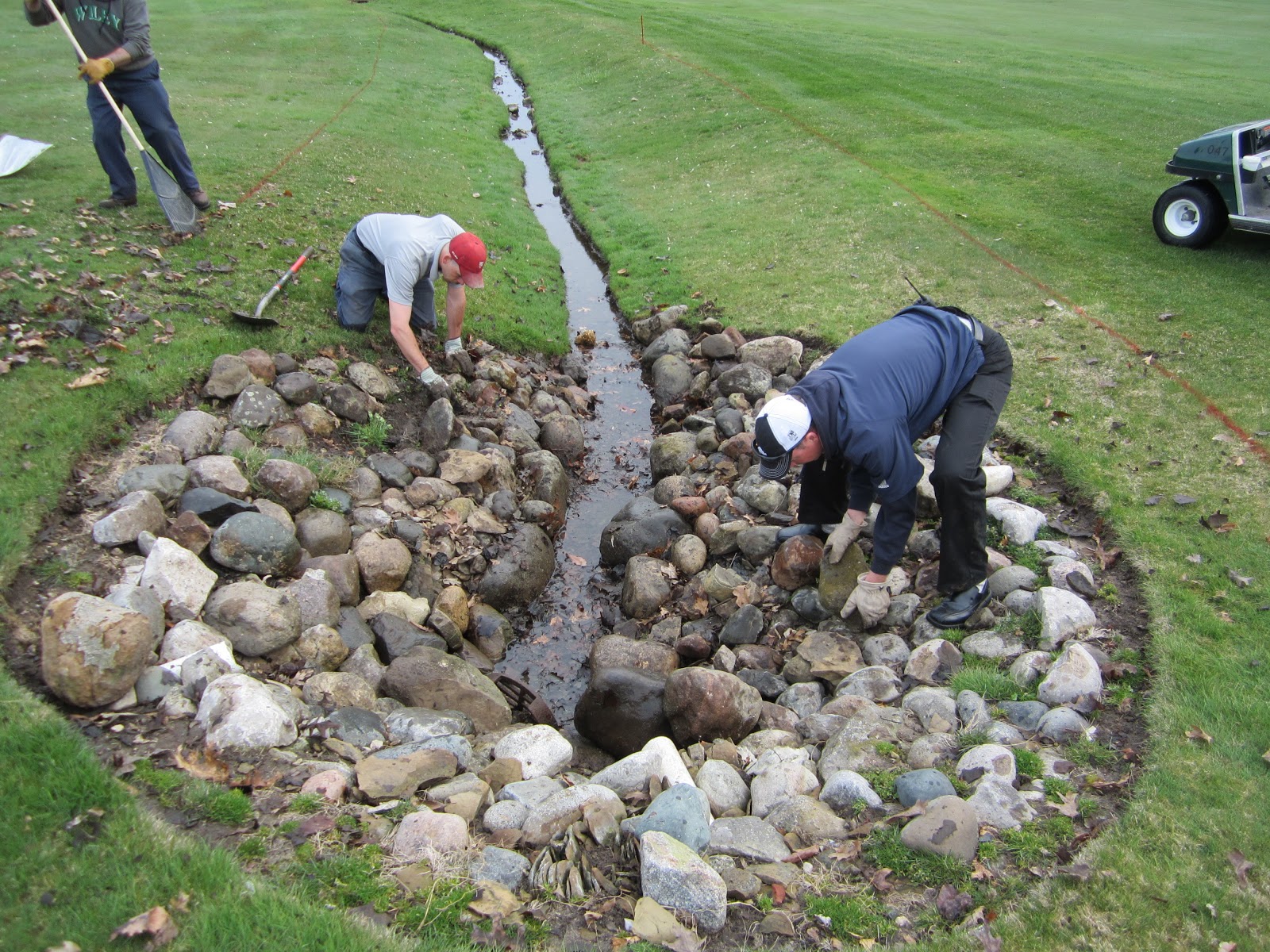
A little attention was needed on the two ends of the creek on #16.  The stone area has been weeded and new landscape rocks added for improvement.  We are also in the process of making new foot bridges for the creek.  You can expect them to be installed next week.

#16 Creek before

#16 Creek after
Removing the fence on #9 and #6.  The split rail fence has been on the property for numerous years.  After repairing it several times during it's existence, it was finally time to part ways.  There will still be a split rail fence on #7 and a couple of isolated areas on the golf course.
 
Removing the fence

Roadside afterwards